Kavi Arasu

Watching The Wind Work

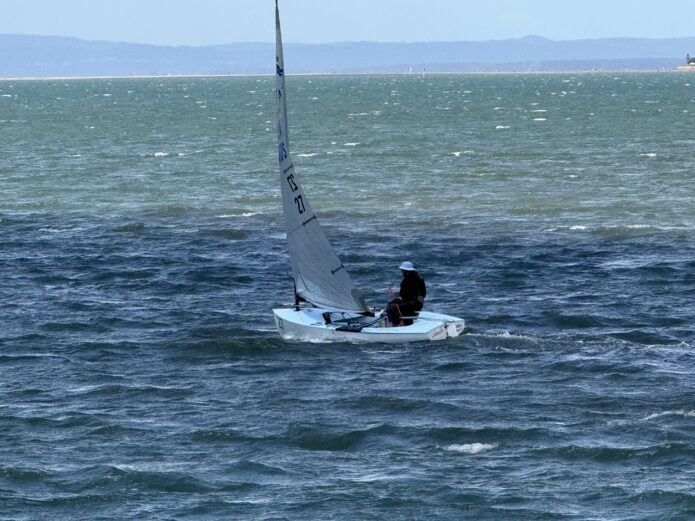
One bright afternoon in Manly, I stood by the water and found myself watching the wind work. The sea was calm, the sky spotless, and a light breeze played around like it had nowhere in particular to be. Then a boat caught the wind, its sail filled, it leaned slightly, and began to move. Just like that.

You cannot catch the wind with your hands. You can wave, grab, or plead, but it slips right through. Yet stretch a bit of cloth in the right way, and the same wind will take you places. The trick is not strength, but alignment.

We do this in life all the time. We try to hold on to things we cannot. Control people. Plan every detail. Manage every outcome. All we end up doing is flapping about like a loose sail. The world moves anyway; the only choice we have is how we set ourselves to it.

The sailors made it look effortless. A tug on a rope here, a small turn of the wheel there, a quiet adjustment to the wind. They did not fight it; they worked with it. When the wind changed, they changed too. Calmly. In rhythm.

Lessons from the Shore

Perhaps that is what wisdom looks like. Knowing when to act and when to let the wind do its work.

And yes, there was a little competition too. You could see one sailor glance sideways at another, quietly comparing. Humans will be humans. Even grace comes with a touch of rivalry.

Standing on shore, I realised that the boats moving best were not the ones straining hardest. They were the ones that had learnt to work with the wind.

Maybe that is the real art of living. You cannot hold the wind. You can only understand it, trust it, and let it carry you forward.

PS: Here are some other posts from the trip down under.

The Brown Snake and I

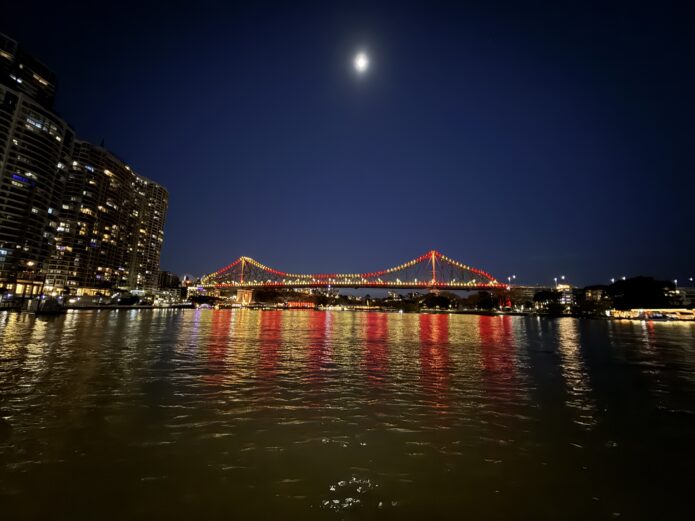
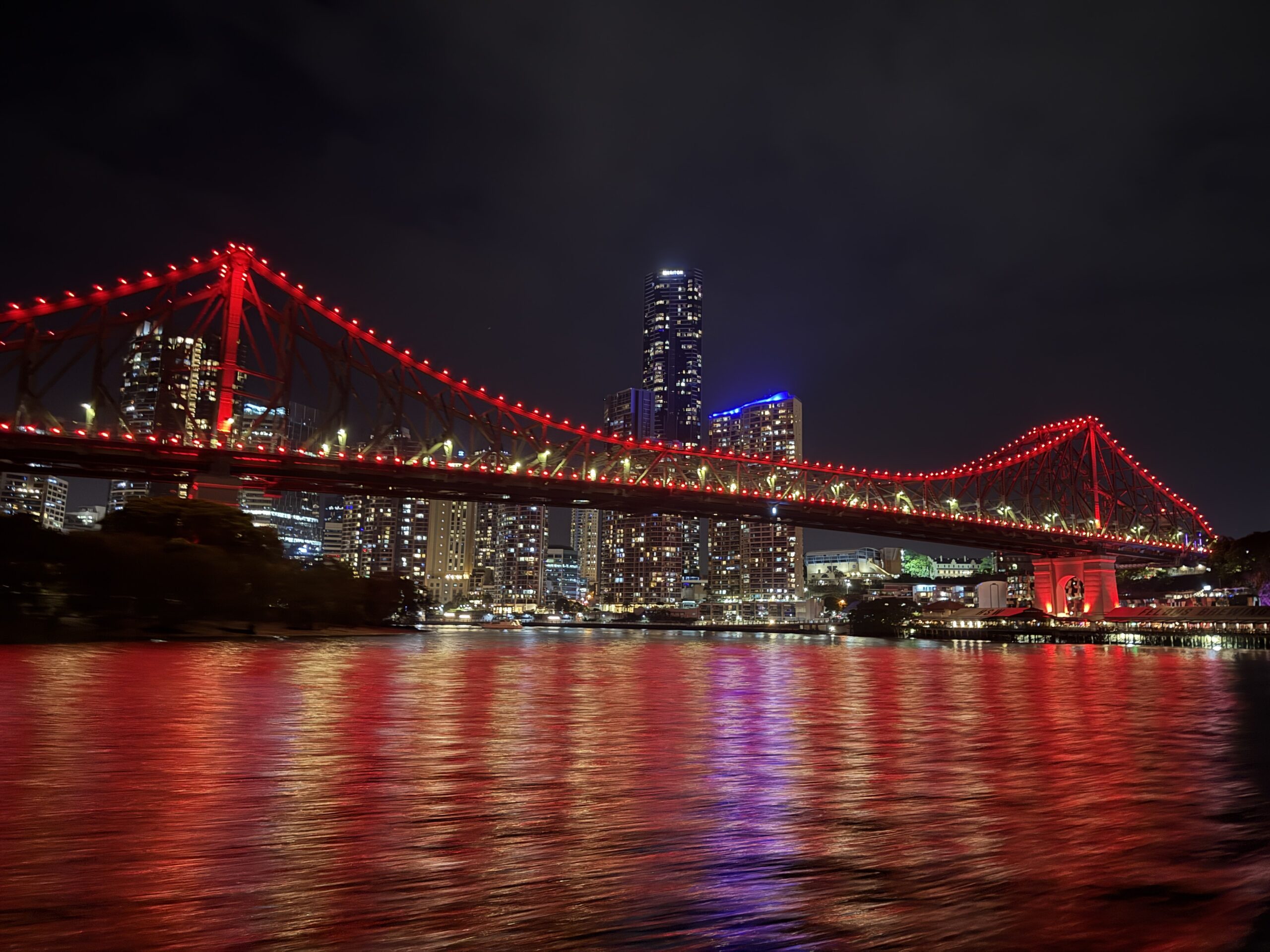
It was one of those Brisbane evenings that felt neatly put together. The moon hung above the Story Bridge, the bridge glowed in red and gold, and the river below reflected it all as if it knew its role.

This is the Brisbane River. But long before it became a postcard, it was Maiwar. The river of the Turrbal people, the first caretakers of this land. They lived along its bends for thousands of years before Europeans arrived in the 1820s. For them, the river was everything. Food, road, temple, and teacher.

The Meeting Place and a Cricket Fortress

The Turrbal people had names for every turn of the river. Woolloongabba meant “meeting place.” It still lives up to that name. It is now home to the famous cricket ground, The Gabba, where every few years India meets Australia to settle who really runs cricket.

In 2003, Sourav Ganguly’s brave century on a green, bouncy pitch showed that India had grown tired of being called timid. Then in 2021, a young, injury-hit team came back to do the impossible. Breaking Australia’s 32-year unbeaten record at the Gabba with courage, calm, and a touch of cheek.

It wasn’t just a win; it was a story of belief and joy. Many said the fortress had fallen. I thought otherwise. In fact, the Gabba stood taller for it. It proved again why sport matters: to host rivalries, to test effort, to stretch courage, and to honour that often-abused but still-revered phrase, the spirit of the game.

Funny how I started writing about the river and ended up at the cricket ground. But then again, the river has seen it all. Floods, bridges, and the odd boundary.

The River That Refused to Straighten

People call the river, ‘Brown Snake’. And the name fits. It winds through the city, calm and sure of itself. People jog along it, sail on it, build towers beside it and sometimes, when it floods, remember who’s really in charge.

Along its banks, the city gathers quietly.

Queensland’s Parliament House sits near one of the curves, looking calm and serious as if the river is ready with the next question. The kind that would embarrass a minister and still ask the opposition what they were doing all this while. A little further down, government offices line the shore, their glass windows catching the light. Across the water, old timber homes in Teneriffe stand beside tall new apartments, both pretending they belong together.

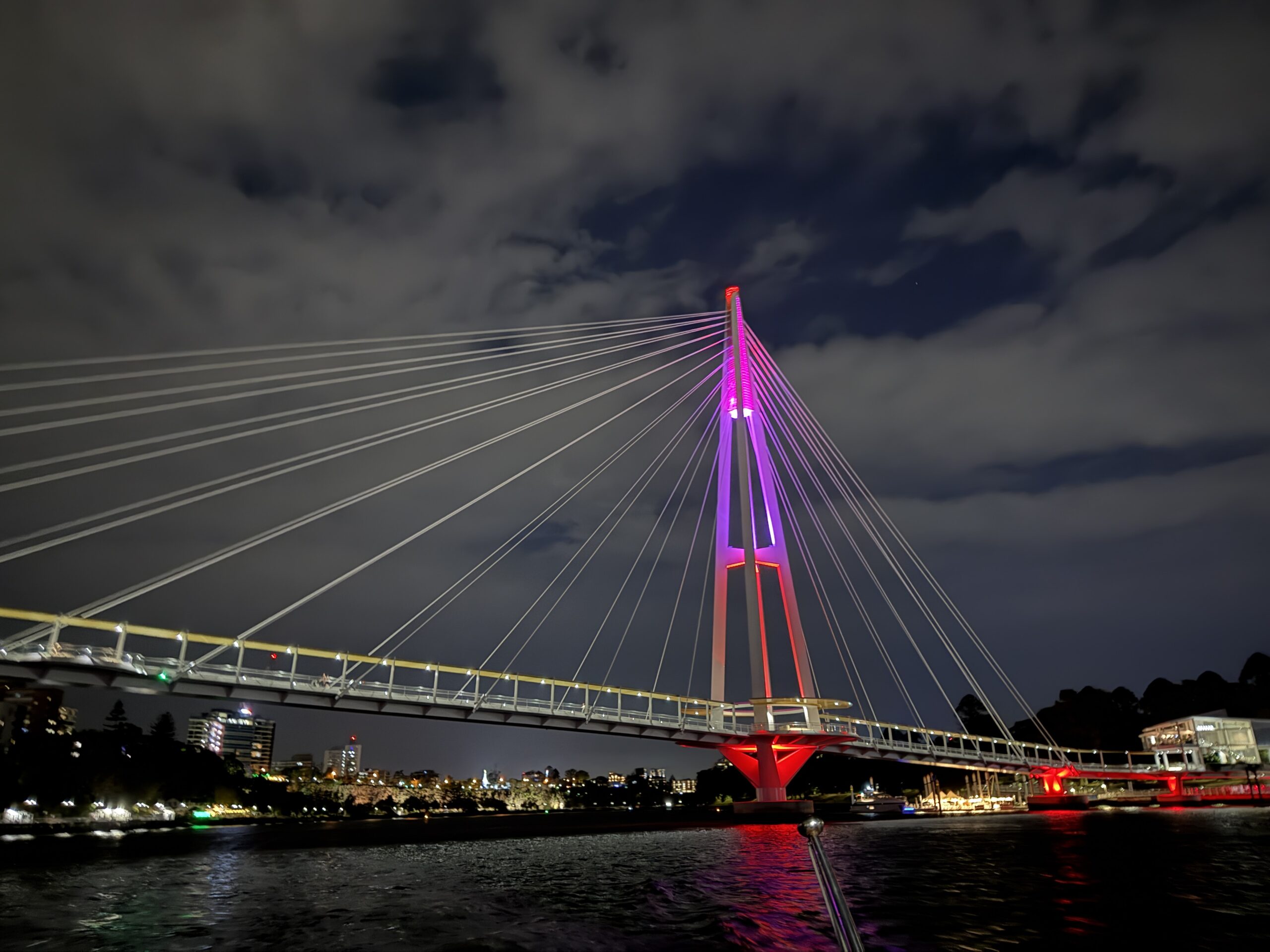
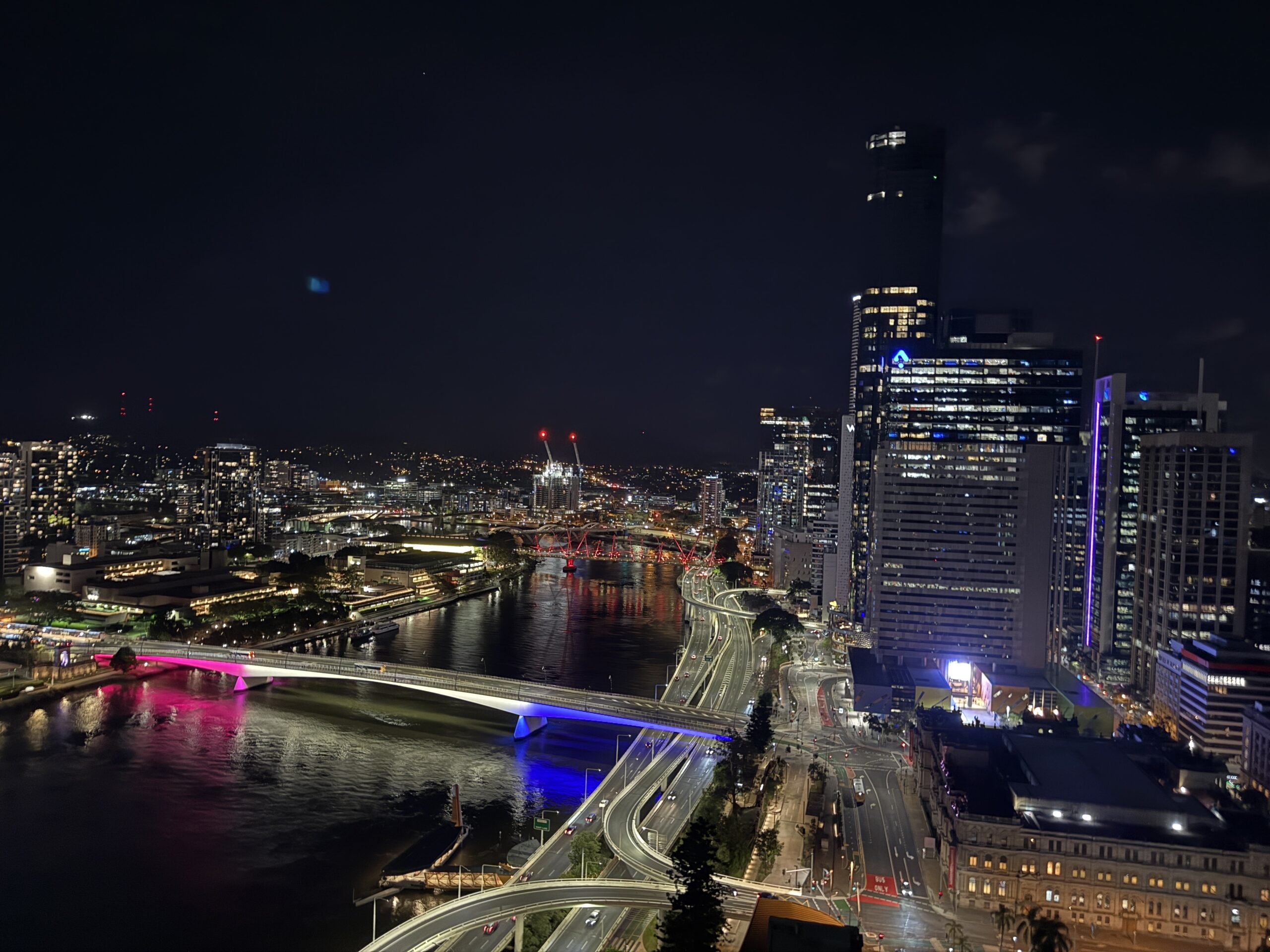
Kurilpa Bridge — a web of light and steel across the Brisbane River. It carries walkers, cyclists, and late-night wanderers
Kurilpa Bridge — where steel meets stillness, and the Brown Snake plays along.
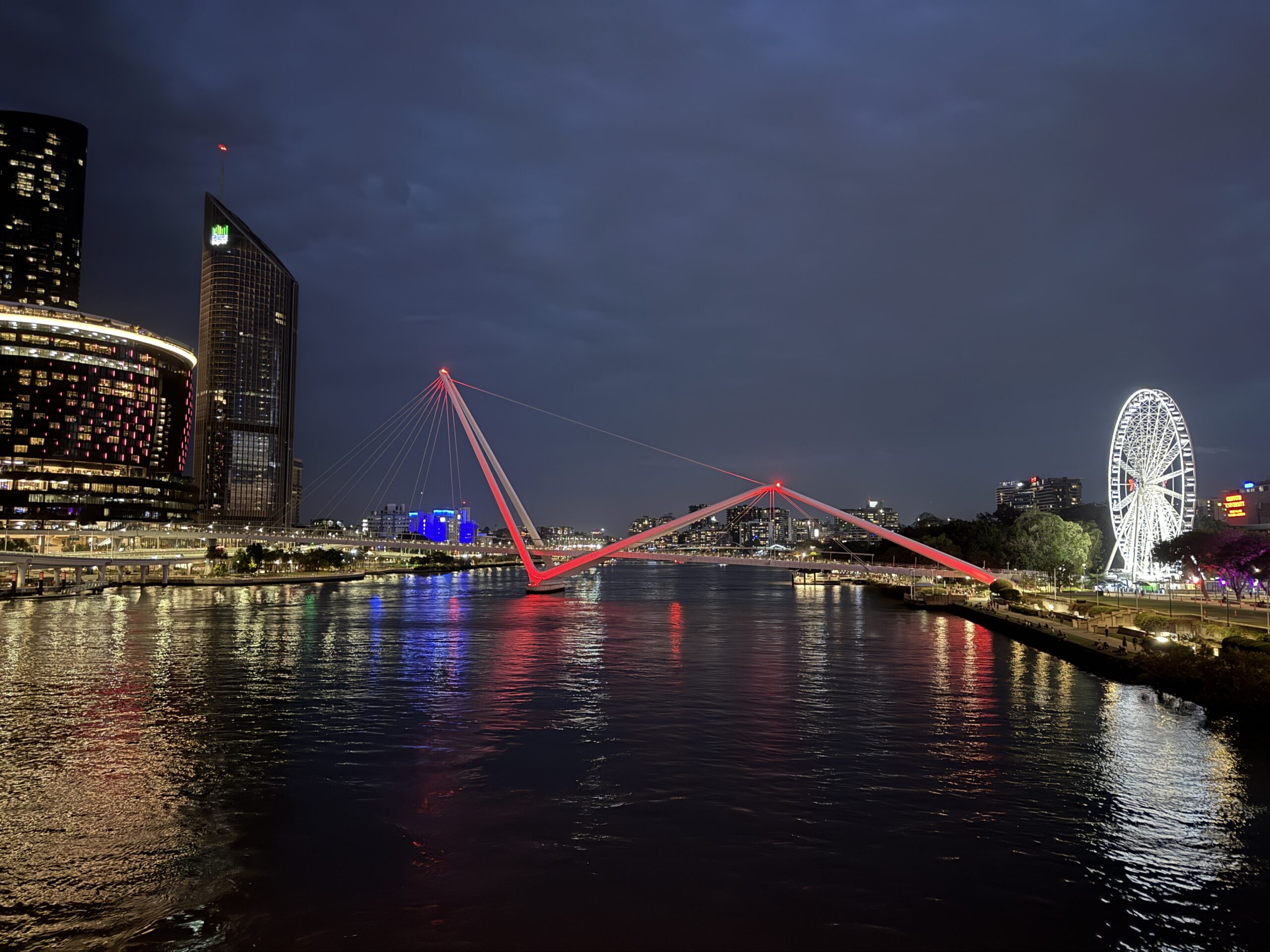
The Neville Bonner Bridge — Brisbane’s newest way to cross the Brown Snake, or to stop halfway and take another photo of it.

At South Bank, the Wheel of Brisbane turns slowly over the river. It’s a giant Ferris wheel that looks like it’s keeping an eye on the city. At night, its lights shimmer on the water, mixing with reflections from cafés and bridges. Downstream, near the University of Queensland, students walk and talk by the water, thinking of exams, futures, and maybe nothing at all. The Brown Snake watches them all, moving quietly past.

The Brisbane River tracing the city’s heart . A ribbon of water, movement, and memory.

Later that night I read how early European settlers once tried to make this river straight. They brought dredges and plans, confident they could tidy nature’s design. The Brown Snake was fiercely Australian. It refused and kept curving and silting as it pleased, reminding everyone that some things are meant to meander.

Bridges, Lights, and the CityCat

Sixteen bridges now cross this river. The old Victoria Bridge has been rebuilt more than once. The Story Bridge, born in the Depression years, is Brisbane’s favourite landmark. Every night it glows like a festival — blue, gold, purple — changing colour depending on what the city is celebrating or mourning.

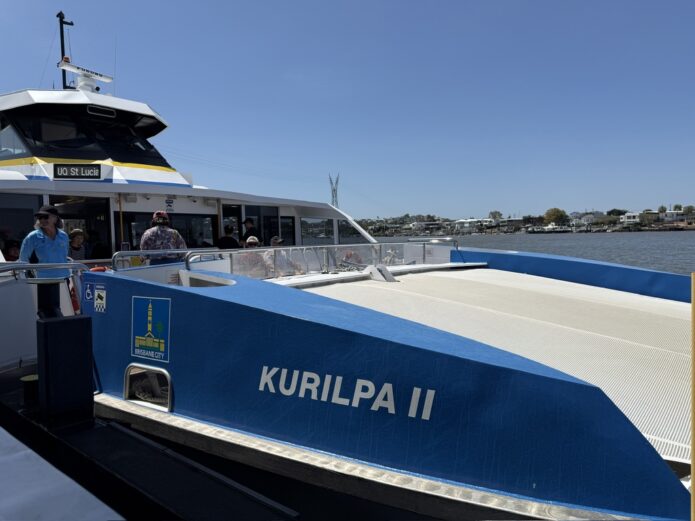
I took the CityCat a few evenings. Long, sleek, and painted in cheerful blues and whites, it glides along the river like a quiet promise. Office workers scroll on their phones. Tourists seem to take the same photo over and over. An extended hand holding a phone and clicking a picture is a standard feature! Somewhere, a child points at the moon.

The Story Bridge. Proof that even steel can smile when the lights come on.
The Brown Snake seen from above. Calm, luminous, and endlessly patient, holding Brisbane in its curve.

On one side, picture-perfect apartments lean over the water, all glass and balconies. On the other, green parks and old timber wharves stand calmly, pretending not to notice. The air smells faintly of salt and weekend plans.

The Rivers That Made Me

Somewhere between two stops, my mind wandered home. To Madurai. To the Vaigai. The river I grew up by. Once the pride of the city, now mostly a trickle between bridges that are newer than the water beneath them. Still, people cross, live, and hope. That’s what bridges are for.

And then I thought about space and wondered how many people live per square kilometer relative to spaces that I am used to.

Brisbane breathes at around 176 people per square kilometre.

Madurai hums at 8,800.

Mumbai roars at 33,000.

For ordinary people, that’s not density. That’s destiny.

Here, everyone seems to move. Running, rowing, cycling, sailing. But try getting a doctor’s appointment, and you’ll learn what patience truly means. The Brown Snake has its own pace, and so does the city.

Vaigai trickles. Maiwar flows. Mumbai surges. Each carries its own rhythm and lesson.

What Rivers Teach Us

As the CityCat slipped under the Story Bridge, the moon brightened above, and the Brisbane River — the Brown Snake — shimmered gold. The ferry hummed softly, carrying people home, and I felt the city exhale.

My mind darted back to the waters I’ve known: the restless sea in Mumbai, the fading Vaigai in Madurai, and this calm, brown river in Brisbane. Each carries its own rhythm . The sea crashes, the Vaigai sighs, the Brown Snake flows and forgives.

Mumbai teaches me motion. Madurai teaches me memory. Brisbane, perhaps, teaches me stillness and flow. Together, they remind me that home is not fixed to a pin on a map. It is a current that carries you forward, again and again, asking you to move, to meander, and to remember.

Rivers don’t just flow; they hold time. They carry stories we’ve forgotten how to tell. Stories of people, floods, bridges, and beginnings. The Brown Snake has watched Brisbane rise, falter, and rise again. It asks for nothing, but it seems to remembers everything.

Maybe that’s what rivers teach us in the end . That strength isn’t about speed or noise, but about keeping on, quietly, towards the sea.

Between the Big Blue Sky and the Brown River

I met him on the CityCat. Brisbane’s river ferries glide along the brown river, under bridges that look like bent straws, past cafés and joggers who seem permanently cheerful.

Joseph was a deckhand. A big native Australian with shoulders that looked built for the river. His job was to haul the rope, open the gate, wave people in, and make sure no one fell into the water. He did this every few minutes, at every stop. Do that a hundred times a day and anyone would be bored to death.

Not Joseph.

He moved like it was his first day at work. Cheerful. Focused. Alive. There was a bounce in his step and a twinkle that matched the river’s shimmer.

It was a Sunday evening. I had time to kill, so I stayed on the ferry all the way to Hamilton, where the boat turns and snakes back again. When we docked, I asked him, “What makes you smile and work so hard?”

He paused, smiled wider, and said, “I love the river. I love the big blue sky. This river is mine. This sky is mine. And when you come on board, sir, it gives me joy to take care of you.”

It wasn’t corporate enthusiasm. I’ve been around long enough to smell PowerPoint sincerity from a mile away. This was real.

We started talking. We spoke about people, work, and how both of us survived Covid. His words were simple, but the kind that stay with you. As I left, he said, “Take care, mate. Come back soon.”

A few days later, I boarded a Singapore Airlines flight home. The service there is famously polished, like chrome. An air hostess with a more than merely perfect smile welcomed me aboard. Encouraged by Joseph, I asked the young lass the same question.

“What makes you smile and work so hard?”

She smiled her perfect smile. The kind they probably practise before every flight. She thought for a fleeting second, and delivered her answer with the poise and precision Lee Kuan Yew might have admired.

“I have to,” she said. I liked her honesty and told her that.

Through the flight, she was impeccable. Efficient. Precise. Polite. Nothing wrong. Nothing missing. Except something invisible.

As I got off, I said, “Good luck.” She blinked, surprised. Then said, “Goodbye, sir,” and went back to her line of farewells.

Two smiles. One sculpted by discipline; the other shaped by the river and the sky.

Between the big blue sky and the brown river perhaps lies the distance between precision and presence.
Between duty and delight.
And between, having to and wanting to.

The Light Within Resilience

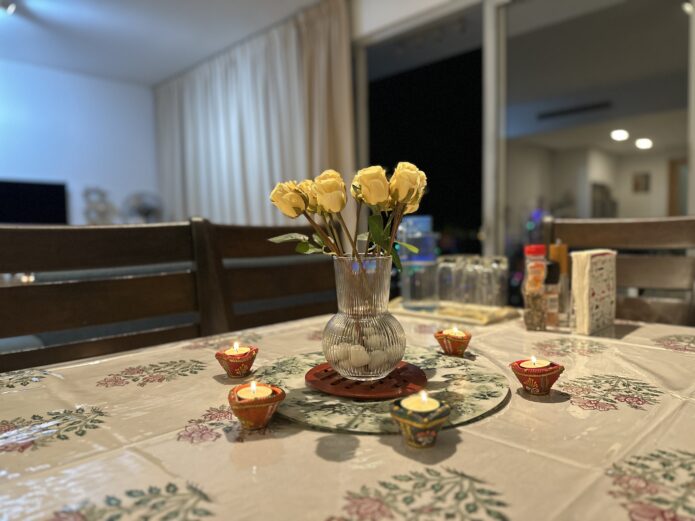
It’s Diwali. Deepawali as it’s called back home. The word comes from deepa (lamp) and avali (row) — a row of lights that celebrates the victory of clarity over confusion, of faith over fear.

Every story behind this festival begins in darkness.

Ram returns to Ayodhya after exile. Krishna ends Narakasura’s reign. Kali restores balance when chaos reigns. Guru Hargobind walks free from Jahangir’s prison, taking fifty-two kings with him into freedom. Of course, there is more. Each story carries the same thread — a new beginning after struggle, a moment when courage finds its footing again.

Resilience often begins quietly. It starts when everything feels uncertain, yet something inside whispers, try again. It grows when we pause, look around, and ask, what still holds true?

Finding Light – within and around.

There is much darkness in the world today — conflict, fatigue, and loss. Yet if you look closely, there are sparkles everywhere.

Like the taxi driver who tells me he is doing one extra round after a fifteen-hour day so the old-age home he supports can have more sweets for Diwali.

The air hostess who wipes away a tear as she wished me back a happy Diwali. Her first one away from home after being married for three weeks.

The corporate head who breaks down privately after losing colleagues in a freak accident, yet steadies himself so others can lean on him.

My newspaper agent in Madurai who still walks up, asks how I am, and waits — really waits — for an answer.

A neighbour who lost her husband but still smiles, still finds small ways to be kind, still shares a bit of joy.

Light finds its way through people like them. Human beings, in their everyday acts, are remarkably resilient.

Resilience is the art of standing up again. As Albert Camus wrote, “In the depth of winter, I finally learned that within me there lay an invincible summer.”

So if the light around you feels faint, light a small lamp anyway. If your work, your idea, or your courage feels tired, let Diwali remind you that the glow returns in time. In people. In you.

May you find the light within, even as the ones on the window sills flicker bright. And may you notice the light in others. The kind they may not wear on their sleeve, but quietly keep alive for the world.

Happy Diwali.

Spilled Water, Sharp Wit, and a Lesson in Leadership

It was a long oak table. The kind around which serious men in serious suits talked serious strategy.

The Managing Director was about to make a big presentation. Papers needed to be passed around.
Years ago, as a junior manager, I’d been entrusted with setting it all up. I grabbed the opportunity with both hands. Possibly legs too.

I had worked closely with the CEO. Learnt a ton. And put it all together like my life depended on it. Because, frankly, it felt like it did.

People filed in. The room filled up. And just as the meeting was about to begin, Murphy showed up. My elbow hit a glass of water. It emptied itself on the neat sheaf of the CEO’s printed presentation. Numbers, projections, strategy, all now soaking in regret.

Right then, the CEO walked in. I froze. So did time.

He looked at the mess, smiled, picked up the damp stack, and said:Well, here’s a watered-down version of next year’s strategy.”

The room erupted. The tension vanished. The meeting was sharp, alive, and unexpectedly joyful.

And I learnt something I’ve never forgotten: The best leaders don’t just stay calm in a crisis. They know when to crack a joke.

These days, humour has become something else. It’s often loud. Crass. Sharp-edged. Reduced to personal attacks, one-upmanship, and clever jabs. It’s lampooning more than laughing. And it leaves no room for dignity. Only applause or offence.

Which is a pity. Because true humour of the quiet kind, the kind with timing and taste, adds a certain sophistication to everyday life.

It disarms. It connects. It shows perspective. It’s not about who can say the most outrageous thing as much as it about holding the moment lightly, without letting it slip.

Stanford thinks so too

At Stanford’s Graduate School of Business, Professors Jennifer Aaker and Naomi Bagdonas teach a popular course called Humour: Serious Business. Their research is clear: humour is an underrated superpower in leadership.

Used well, it boosts trust, increases engagement, and makes communication stick. More interestingly, humour makes leaders appear more competent, not less.

Because being able to laugh — and more importantly, to make others laugh, signals something powerful: you’re comfortable. You’re present. You’re not afraid of the room.

And the very best leaders? They don’t just use humour. They can take a joke too. Without flinching. Without getting defensive. Often, with a smile and a comeback that lifts the moment rather than hijacks it.

Humour is the glue

There’s a Japanese art form called kintsugi. It involves repairing broken pottery using gold. The cracks are not hidden. They’re highlighted. Because the break is part of the story. And the gold, quite literally, holds it all together.

I think humour plays a similar role in leadership. When things crack, as they often do, humour is the gold we can pour into the situation.

It doesn’t erase the problem. But it holds the room together, highlights resilience, and reminds everyone that we can move forward. With perspective.

The best part? Once you’ve laughed with someone, it’s much harder to stay divided.

So how do you cultivate this?

Start by observing. Noticing moments of lightness or the ones begging for it. I once worked with a manager who was famous for his campus presentations. He would rehearse meticulously, plan every slide and then grin and say,

“In the fifth minute, I’ll crack a spontaneous joke.”

Yes. Spontaneous, by appointment. And strangely, it worked. The room laughed. Every time. For some people, humour is a performance. 

But for the truly great ones, it’s a practice. It comes from noticing. From being present. From taking small risks. And yes, from being open to taking it on the chin when it doesn’t land.

The next time you’re in a heavy meeting, watch what lifts the room. It’s rarely slide 47. It’s often a well-timed comment. A look. A line. Something small but true.

Read people who write with wit. Hang around people who laugh easily, not just loudly. And most importantly, practise on yourself. Learn to take a joke. Especially about yourself. That’s the real test. And the best training ground.

The Closing Line

This is not a call to turn every meeting into a stand-up set. At best, It’s a quiet reminder that in ‘serious’ rooms , a well-timed laugh can change everything.

It humanises the moment.

Because humour, when done right, doesn’t just break the ice. It becomes the gold that mends the cracks. The pause that helps the room breathe. The tiny spark that reminds us: we’re all in this together. Elbow, water spills and all.

And maybe, just maybe, the best way to hold the room, is to let it laugh.

What Does Success Mean?

The other day I chanced upon Kipling’s If. The kind of find that comes when you are lazily flipping through an old journal. My younger self had copied the poem there, in a steadier hand.
That poem has travelled with me across the years.

It made me pause. Again. As it always does. It made me wonder: what are my own markers for success?
Now.
How have they shifted as new conversations arrive at my shore, every day? As new books, ideas, and lived moments at work reshape me? Or have they?
I reached for a pad and pencil.

So, what is success?

Three things.

Success is to reinvent. To see the changes around us and not be afraid. To bend, to stretch, to become.
Not to chase every trend. But to stay alive, awake, in touch with the times. To move with them, yet remain yourself.

Success is to believe that better is possible. Better is not more. Not louder. Not heavier.
Better is lighter.
Cleaner.
Full of meaning. It asks for courage.
It is nourished by curiosity. And thrives on humility. Every day offers the chance to try again. To make one corner of life, work, family, self a little better than before.

Success is to give. And then give again. Not because you have plenty left over. But because giving itself makes you full. It is the circle of life made visible. To give is to know you are alive. To give is to know you are enough.

That to me, is success. Now.
Reinvention.
Belief in better.
The grace of giving.

Yours?

Not a Travelogue. A Checklist.

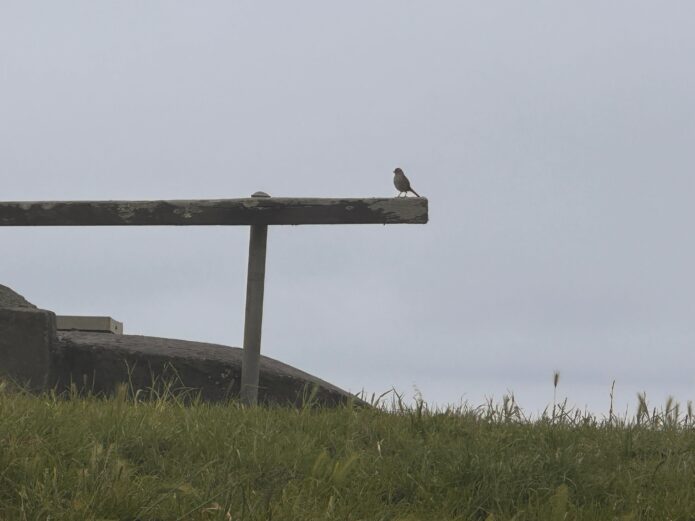
The bird sits alone on a weathered post. San Francisco breathes behind it. Fog rehearses its entrance. The Bay keeps secrets and receipts. Waves clap lightly, like polite applause. The bird doesn’t bow. It just is.

We chase bigger stages. The bird chooses a better stance. Small can be vast when attention is full. Presence is the original zoom.

What’s the moral? None, if you need a twist. Plenty, if you need a nudge. Simplicity survives weather. Patience outflies drama. Focus is free and expensive.

If you must take a selfie, include the horizon. If you must take a call, keep it short. If you must take advice, take it from the wind. Lean, then let go.

One bird. One post. One city that never agrees with itself and somehow works.

And that is enough for today.

Win or Die: Notes from a Noisy Nation

“There are only two possibilities here, right? Win or die.”
That’s not a war general. That’s Aravind Srinivas, CEO of Perplexity AI.

He said this after his fledgling startup made an audacious offer to buy Google Chrome just as Google was considering acquiring his company. It wasn’t a stunt. It was a statement. Stand your ground. Don’t wait to be chosen. Act. Or disappear.

The clarity in those three words hit me harder than I expected. Because it reminded me of something else entirely: home.

A few months ago, I was traveling overseas. I was in Queensland, Australia. Clean air. Empty roads. Birds louder than people.

A woman who had once travelled to India leaned in and asked, not unkindly, “How do you live there? You’re packed like sardines.”

Fair question. All of Australia has as much people as in the city of Mumbai. We are packed. In trains. In queues and contradictions. We live close—to each other, to chaos, to survival.

And for millions, survival itself is a kind of victory.

India Wasn’t Meant to Make It

In 1947, perhaps that was the national mood. Survival. That’s all we had. A bruised nation, a broken economy, and a whole lot of people with very little of everything else.

India wasn’t meant to make it. Winston Churchill famously scoffed that India was just a “geographical expression” and predicted it would splinter into chaos after the British left.

We were a “developing country” before the term became polite. A country stitched together by courage and imagination.

And Yet—Here We Are

Seventy-eight years later. Messy. Loud. Functionally dysfunctional. Fractious. But moving. Rising.

There are parts of India today that can beat the world on any stage. Others still trying to find the stage. And yet others just finding their feet.

We are world-class in patches and at cross purposes in others. But we are trying. We are showing up. That counts. India is no superpower. But it is a super possibility. Our lived experiences vary more than all climate zones of the world. But deep down, the story is the same. The fight is the same.


One. Because of Many.

What makes India remarkable isn’t just its size or scale—it’s its stunning, often stubborn, diversity. Languages, cultures, cuisines, gods, gods within gods. We are made up of parts. Gloriously different parts. And yet, we are one. Not in spite of our differences, but because of them.

This plural existence that is messy, layered and opinionated is not a bug in the system. It is the system.

It may look inefficient from a distance. And may confound those seeking sleek, clinical uniformity. But in India, sameness has never been the soul. Diversity is. And that predates independence!

To truly be Indian is to celebrate that. To respect what is not ours. And honour where we came from. And to defer, with humility, to where we are headed.

We can disagree—on politics, beliefs, or the best way to eat dosa. But when we hold hands, we can move forward. That is our superpower.

One. Because of many.

Victory Means Living Fully

Victory, my dad used to say, is living to your full potential. Anything less, and something inside quietly dies. You may not acknowledge it at first. But a part of you knows. And shrinks a little further each time.

That’s the real journey. Especially for a country like ours. To go from simply surviving to fully showing up.

From “How do you live there?” to “How do they do that?” That arc takes courage. Not the loud, chest-thumping kind. But the quiet, daily, persistent kind.

The kind that keeps going even when things seem okay. The kind that still believes.

Aravind Srinivas’s clarity in that pithy statement reminded me of the many times India has stood at a cliff’s edge and chosen to jump forward—uncertain, unready, but unwilling to back down. Here are my top five moments India had no choice but to Win or Die. Of course, these are through my imperfect lens. And you would have yours!

Five Moments India had no choice but to show up. And win!

1. 1991: Economic Liberalisation

India was on the brink. Foreign reserves were down to a few weeks. A default loomed. As a last resort, the government flew out gold reserves to secure emergency credit. In response, Finance Minister Manmohan Singh and Prime Minister Narasimha Rao dismantled decades of economic protectionism. And how! The reforms were unpopular. Risky. Uncertain. But the alternative was collapse. That pivot didn’t just save the economy. It opened up opportunity for millions. Win. Or die.

2. 1960s–70s: The Green Revolution

Post-independence India was trapped in a cycle of food shortages and foreign aid.
Famines were frequent. Hunger was normalised. Then came a wave of scientific intervention: high-yield seeds, irrigation projects, fertilisers. Led by M.S. Swaminathan and supported politically, the Green Revolution transformed agriculture. India went from begging for grain to becoming self-sufficient. And feeding a large and growing population! More than food, it was about dignity. Win. Or die.

3. 1983 & 2011: Cricket World Cup Wins

In 1983, India entered the World Cup as rank outsiders. The West Indies were expected to cruise.
But Kapil Dev’s team defied every expectation and rewrote history at Lord’s.
It wasn’t just a cricketing upset. It was a shift in national imagination: maybe we can win.
In 2011, the stage was different. India was expected to win. But the pressure was immense.
When Dhoni hit that final six, it wasn’t just a sporting victory—it was emotional closure for a generation.
Two decades. Two trophies. (Read more)
Same mindset: Win. Or die.

4. 2016 onwards: The Data Disruption

Before 2016, mobile data was expensive and unevenly distributed. Internet access was a luxury in many parts of the country. Reliance’s Jio changed the game. Offering cheap data and forcing every telecom operator to adapt or perish. It became more about participation than a phone plan. Rural India started streaming. Teenagers started coding. Small businesses went digital.
Digital inclusion became the new frontier. Win. Or die.

5. 2010s – Present: Aadhaar and UPI

How do you bring a billion people into the financial system? You start by giving them a unique identity—Aadhaar. You link that to banking, subsidies, and digital payments. And build UPI. Today, Indians make millions of real-time transactions a day without cards or cash.
It’s not flashy, but it’s revolutionary. No other country has done it at this scale, with this quiet confidence. Win. Or die.

The Thread That Connects Them All

There are countless others. Partition. Operation Flood. The space programme. The vaccine rollout. Operation Sindhoor. Kargil and other wars. And so on. Besides the ones that make it to the news, there are several personal and community triumphs in unnoticed corners of the country. All of them have imperfections galore. But each one is stitched with the same thread: courage in the face of reality. The refusal to be defined by what is. And the constant push to discover what could be.

More in the Tank

Because in this messy, magnificent democracy of ours, there is always more fuel in the tank of potential. Something that we can access when we come together with mutual respect and collective intent. And when it comes to embracing Win or Die, the latter isn’t really an option.

Happy Independence Day.

Tattoos, Then and Now

I once turned down a tattoo at a party.
It was temporary, would fade in a week, and involved no pain. Still, I said no.

My daughter was horrified. Her face said, “Who in the world would miss such an opportunity?” As if I had refused free chocolate.

I shrugged and reached for a fried snack destined to sit on my hips forever.

I didn’t realise that moment would sit in my memory for years, waiting to be triggered by something I read last week.

An Inked Lady in Ice

A research report took me to Siberia. Archaeologists had found a woman from 500–200 BC, preserved in the ice. She was about 50 when she died — and she had tattoos everywhere.

Using near-infrared imaging, scientists created a 3D model of her skin. Mythical beasts curled around her shoulders. Animals fought for survival across her arms. There were extraordinary hand-poked designs of tigers, griffins and tiny roosters.

It was an art gallery — only the canvas was human.

She was from the Pazyryk people — nomadic herders in what is now Russia, Mongolia, China, and Kazakhstan. Her tattoos were not casual decoration. They signalled identity, status, and protection. They were her résumé, her business card, and perhaps her social media feed — all rolled into one.

Ink Runs in the Family

This felt oddly familiar. I grew up around tattoos.

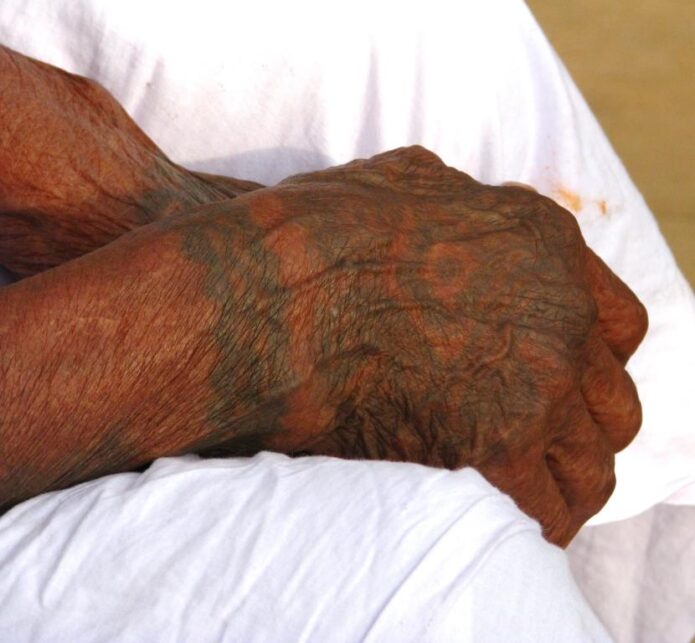
My great grandmother had them all over — arms, fingers. Elaborate patterns, symbols, swirls, and ornate kolam designs. I doubt she picked them from a design book. They probably carried meaning: community, rites of passage, family history.

How she endured them, I cannot imagine. No buzzing electric machines. No numbing cream. Just a steady hand, a homemade needle, and enough pain tolerance to make a dentist cry.

Today, it is far easier. You can walk into a climate-controlled studio, choose from a digital catalogue, sip a smoothie, and emerge with a pristine design in under an hour.

If my great grandmother walked into a modern tattoo studio, she would marvel at the air-conditioning, the choice of ink colours, and the playlists. Then she would quietly ask the tattooist why everyone looked so frightened of the needle.

That generation wore their tattoos with pride. In the photograph above, you see the hand of another grand old lady from our family — a picture I took years ago and dug out for this post. I remember how the wrinkles did nothing to hide the beauty of her ink; if anything, they made it richer.

Why Do People Tattoo?

Psychologists talk about identity, memory, belonging, rebellion, or beauty.
Anthropologists speak of culture, rites of passage, and spiritual protection.
Sociologists mention signalling — telling the world something about yourself before you even speak.

Sometimes, it’s profound: a reminder of survival, a memorial to someone loved.
Sometimes, it’s whimsical: “I was in Goa, the needle was cheap, and I liked dolphins.”

The common thread? Tattoos meaning something — even if that meaning is “I felt like it.”

Cool Again

Tattoos, once the mark of rebels and rockstars, now stroll into boardrooms without causing a stir. The same manager who once frowned at them might now roll up his sleeve to compare designs. The menu has expanded too: minimal line art, crisp geometrics, dotwork, photo-realism, tribal revivals.

If companies truly believe their people “bleed blue,” (or whatever colour) the next brand campaign should be a bulk booking at the local tattoo parlour. That would neatly separate the true believers from the LinkedIn enthusiasts. Wicked, isn’t it? 😉

Should You Get One?

Of course, your call. But in love, work, or belief — would you carry it on your skin for life? If the answer isn’t a loud, unapologetic yes, it probably doesn’t deserve permanent space.

And how would you ever know?
I wish my great grandmother was around for a conversation. One of my questions would be exactly that.

If you’re looking for inspiration, skip the dolphin-on-the-ankle Pinterest board. Check out that 50-year-old Pazyryk lady from Siberia here. Pretty cool I say.

A Manifesto for Reading Beyond Reading

As you enter Mumbai’s Terminal 2’s domestic departure area after the security check, and head towards gates 40-45, there was a favourite bookstore of mine.

Yes. Was.

Because it closed recently. I am usually early for my flights. Sometimes just to get to some books and power my reading. At other times, to see what book catches people’s attention!

I have a sense of loss. I don’t know what will replace it. The frenzy with which eateries pop up everywhere, probably one more eating joint. Maybe a clothing store. Or bags. Always bags. (Sigh).

It makes me think of reading itself. And what we miss.

The Shrinking Discipline of Reading

We’re not just losing the habit of reading books.
We’re losing the discipline of reading anything that asks for more than a glance.

As Stowe Boyd writes, “For millennia, people have offloaded aspects of cognition — such as memory — to written materials. But people still had to do the initial cognitive work of understanding and transposition. And, on the other side, people had to read and comprehend what was written by others, to gain a reflection of the understanding of the author.”

From Written Thought to AI Summaries

Today, that chain is breaking. Reports became memos. Memos became emails. Emails became Slack messages. And now, “people are using AI to read and write even these fragmentary comments.”

Boyd quotes Tom White: “Most books should be articles, most articles should be paragraphs, most paragraphs should be sentences, and most sentences should be silence.”

Here’s the kicker: people won’t read emails beyond eight lines — even from their bosses. God help bosses, did I hear you say? They’re fine. AI is summarising for them.

The problem is assimilation. And, reading is more than just receiving words; it’s processing them. Making connections in your own head. If AI does all the summarising, it’s like outsourcing your gym workout — convenient, but you lose the muscle.

The Unfair Fight for Attention

And let’s be honest — this isn’t going to reverse. The future will bring more screens, shorter bursts of content, and ever‑smarter AI eager to do your reading for you. The reading muscle will only get less exercise.

Kids today grow up in a tilted contest: screens arrive first, books much later. By the time reading is formally taught, the screen has already claimed prime territory in their attention span. Erik Hoel calls this literacy lag.

Which is why the habit of reading has to be seeded early and guarded fiercely. If the tide keeps pulling us toward shallower, faster content, the ability to read deeply will become one of the rarest — and most quietly powerful — skills you can have.

Which brings me to Schopenhauer. Who said, “A precondition for reading good books is not reading bad ones: for life is short.”

These days, the search for what to read is as important as reading itself. For there are more recommendations than reasons. Bestseller badges. Must‑read lists. Reviews that can be bought. And so on.

So, how do you find good stuff to read? Thats the challenge. Only, It doesn’t stop with that.

The Collapse of Common Sense

The other day, I was reading a newsletter by Lauren Razavi. She writes about Frank Furedi’s call to revive ‘common sense’.

Furedi says common sense used to come from slow rhythms and shared streets. We moved through the same places. Worked on the same schedules. Spoke the same language. Words meant the same thing to everyone.

These days, the feed never stops.

The same event can be a conspiracy, a tragedy, or a non‑event — depending on who your algorithm thinks you are. Truth bends to the angle of your timeline. And if truth bends, so does taste. The book that trends in your feed may never appear in mine.

We no longer inherit a set of books, ideas, and references by simply living in the same world. The shared shelf has collapsed. The common understanding has evaporated right under our fingers.

Furedi’s warning is that when those shared cultural anchors disappear, what we once took for granted as common sense no longer comes ready‑made. We have to construct it ourselves — piece by piece.

And that changes reading entirely.

Why Reading Well Matters More Than Ever

When there’s no “everyone” anymore, your sense of what’s worth reading can’t just follow the crowd — because the crowd you see isn’t the same crowd I see.

That makes reading well, harder. It also makes it more important. The choice of books becomes less about taste and more about survival — a way to anchor yourself when the cultural map falls apart.

There’s a Jain proverb: When the student is ready, the master will appear. I think books work the same way.

When I’m ready, the book will appear. In a conversation. In an email. Leap out of a newsletter. Or yes, even from an algorithm that gets it right by accident.

The real work, then, is not just to find books. But to ready myself so the right books can find me.

Reading Beyond Reading

Most people read to get to the last page. I read to explore what the book does to me along the way. Because reading isn’t just about finishing. It’s about what sticks. What shifts. What makes you look at something differently the next morning.

So, here is a manifesto Manifesto for Reading Beyond Reading — for letting the book live on in how you think, speak, and act.

A Manifesto for Reading Beyond Reading

1. Read and reread.
Each book speaks to you differently at different points in your life. Your context shifts. The lines may be the same, but the meaning changes. The book hasn’t changed — you have. I first chanced upon Zen and the Art of Motorcycle Maintenance in my father’s stash of books. Something he tossed at me with a smile. As a high‑schooler, I read the words. Much later in life, it changed my worldview completely.

2. Choose your curators, choose your context.
Curators are sharing their perspective. It’s up to you to make sense of it in yours. If you know a curator’s taste, you won’t be sold — you’ll be choosing. There are the experts and bibliophiles like Shiv Shivakumar, Mal Warwick. There are friends like Manu and Krishna who bring such fabulous richness. And then newsletters, like Founding Fuel‘s, that have been life‑changing in pointing me to books that have altered mental models of life and living.

3. Don’t read in straight lines.
Don’t stick to one subject, style, or form. Travel writing gives you more than geography. Biographies give you timelines woven into events. Business writing offers you frameworks for thinking about work. Fiction often gives you reality checks. Read history, science, memoir, essays, and newsletters. Step into other people’s heads and see how they think — that’s more valuable than any tidy summary of their thoughts wrapped between covers.

4. Slow down.
Buying. Reading. This can be your one rebellion against speed. Some read to finish. I read to open my mind. Joy comes not from “The End” but from the journey and the connections it sparks.

5. Make reading your calling card.
Slip it into your hello: “I’m in the middle of…”. Ask others:

  • What are you reading now?
  • Which book surprised you most?
  • Which book do you keep giving away?
  • If you could reread one for the first time, which would it be?

6. Work your reading.
Scribble in the margins. Fold pages. Argue with the author. Tell a friend about it. Link it to your work. Gift it to someone who’ll love it. A book isn’t finished when you close it — it’s finished when you’ve done something with it. In fact, it’s never truly finished.

7. Let the right books find you.
Stay ready. Be curious. The most important books often appear when you’re ready for them, not when you schedule them.

That’s where I stand. For now.
Tomorrow I may find a new book, and it will smuggle in a new rule.
Until then — what would you weave into this manifesto?