Mumblr Bytes

“I just want to this about that.”
― Steven C. Smith

A Manifesto for Reading Beyond Reading

As you enter Mumbai’s Terminal 2’s domestic departure area after the security check, and head towards gates 40-45, there was a favourite bookstore of mine.

Yes. Was.

Because it closed recently. I am usually early for my flights. Sometimes just to get to some books and power my reading. At other times, to see what book catches people’s attention!

I have a sense of loss. I don’t know what will replace it. The frenzy with which eateries pop up everywhere, probably one more eating joint. Maybe a clothing store. Or bags. Always bags. (Sigh).

It makes me think of reading itself. And what we miss.

The Shrinking Discipline of Reading

We’re not just losing the habit of reading books.
We’re losing the discipline of reading anything that asks for more than a glance.

As Stowe Boyd writes, “For millennia, people have offloaded aspects of cognition — such as memory — to written materials. But people still had to do the initial cognitive work of understanding and transposition. And, on the other side, people had to read and comprehend what was written by others, to gain a reflection of the understanding of the author.”

From Written Thought to AI Summaries

Today, that chain is breaking. Reports became memos. Memos became emails. Emails became Slack messages. And now, “people are using AI to read and write even these fragmentary comments.”

Boyd quotes Tom White: “Most books should be articles, most articles should be paragraphs, most paragraphs should be sentences, and most sentences should be silence.”

Here’s the kicker: people won’t read emails beyond eight lines — even from their bosses. God help bosses, did I hear you say? They’re fine. AI is summarising for them.

The problem is assimilation. And, reading is more than just receiving words; it’s processing them. Making connections in your own head. If AI does all the summarising, it’s like outsourcing your gym workout — convenient, but you lose the muscle.

The Unfair Fight for Attention

And let’s be honest — this isn’t going to reverse. The future will bring more screens, shorter bursts of content, and ever‑smarter AI eager to do your reading for you. The reading muscle will only get less exercise.

Kids today grow up in a tilted contest: screens arrive first, books much later. By the time reading is formally taught, the screen has already claimed prime territory in their attention span. Erik Hoel calls this literacy lag.

Which is why the habit of reading has to be seeded early and guarded fiercely. If the tide keeps pulling us toward shallower, faster content, the ability to read deeply will become one of the rarest — and most quietly powerful — skills you can have.

Which brings me to Schopenhauer. Who said, “A precondition for reading good books is not reading bad ones: for life is short.”

These days, the search for what to read is as important as reading itself. For there are more recommendations than reasons. Bestseller badges. Must‑read lists. Reviews that can be bought. And so on.

So, how do you find good stuff to read? Thats the challenge. Only, It doesn’t stop with that.

The Collapse of Common Sense

The other day, I was reading a newsletter by Lauren Razavi. She writes about Frank Furedi’s call to revive ‘common sense’.

Furedi says common sense used to come from slow rhythms and shared streets. We moved through the same places. Worked on the same schedules. Spoke the same language. Words meant the same thing to everyone.

These days, the feed never stops.

The same event can be a conspiracy, a tragedy, or a non‑event — depending on who your algorithm thinks you are. Truth bends to the angle of your timeline. And if truth bends, so does taste. The book that trends in your feed may never appear in mine.

We no longer inherit a set of books, ideas, and references by simply living in the same world. The shared shelf has collapsed. The common understanding has evaporated right under our fingers.

Furedi’s warning is that when those shared cultural anchors disappear, what we once took for granted as common sense no longer comes ready‑made. We have to construct it ourselves — piece by piece.

And that changes reading entirely.

Why Reading Well Matters More Than Ever

When there’s no “everyone” anymore, your sense of what’s worth reading can’t just follow the crowd — because the crowd you see isn’t the same crowd I see.

That makes reading well, harder. It also makes it more important. The choice of books becomes less about taste and more about survival — a way to anchor yourself when the cultural map falls apart.

There’s a Jain proverb: When the student is ready, the master will appear. I think books work the same way.

When I’m ready, the book will appear. In a conversation. In an email. Leap out of a newsletter. Or yes, even from an algorithm that gets it right by accident.

The real work, then, is not just to find books. But to ready myself so the right books can find me.

Reading Beyond Reading

Most people read to get to the last page. I read to explore what the book does to me along the way. Because reading isn’t just about finishing. It’s about what sticks. What shifts. What makes you look at something differently the next morning.

So, here is a manifesto Manifesto for Reading Beyond Reading — for letting the book live on in how you think, speak, and act.

A Manifesto for Reading Beyond Reading

1. Read and reread.
Each book speaks to you differently at different points in your life. Your context shifts. The lines may be the same, but the meaning changes. The book hasn’t changed — you have. I first chanced upon Zen and the Art of Motorcycle Maintenance in my father’s stash of books. Something he tossed at me with a smile. As a high‑schooler, I read the words. Much later in life, it changed my worldview completely.

2. Choose your curators, choose your context.
Curators are sharing their perspective. It’s up to you to make sense of it in yours. If you know a curator’s taste, you won’t be sold — you’ll be choosing. There are the experts and bibliophiles like Shiv Shivakumar, Mal Warwick. There are friends like Manu and Krishna who bring such fabulous richness. And then newsletters, like Founding Fuel‘s, that have been life‑changing in pointing me to books that have altered mental models of life and living.

3. Don’t read in straight lines.
Don’t stick to one subject, style, or form. Travel writing gives you more than geography. Biographies give you timelines woven into events. Business writing offers you frameworks for thinking about work. Fiction often gives you reality checks. Read history, science, memoir, essays, and newsletters. Step into other people’s heads and see how they think — that’s more valuable than any tidy summary of their thoughts wrapped between covers.

4. Slow down.
Buying. Reading. This can be your one rebellion against speed. Some read to finish. I read to open my mind. Joy comes not from “The End” but from the journey and the connections it sparks.

5. Make reading your calling card.
Slip it into your hello: “I’m in the middle of…”. Ask others:

  • What are you reading now?
  • Which book surprised you most?
  • Which book do you keep giving away?
  • If you could reread one for the first time, which would it be?

6. Work your reading.
Scribble in the margins. Fold pages. Argue with the author. Tell a friend about it. Link it to your work. Gift it to someone who’ll love it. A book isn’t finished when you close it — it’s finished when you’ve done something with it. In fact, it’s never truly finished.

7. Let the right books find you.
Stay ready. Be curious. The most important books often appear when you’re ready for them, not when you schedule them.

That’s where I stand. For now.
Tomorrow I may find a new book, and it will smuggle in a new rule.
Until then — what would you weave into this manifesto?

The Real Deal Isn’t Signed

Many moons ago, as a teenager, I had a bad fall while riding my bicycle. A sharp stone hit my head. I started bleeding and eventually passed out on the road. There were no phones. No emergency helpline. Just the road, my bleeding head, and the sky above.

But help came.

A few passing strangers stopped. They sprinkled water on me. Teased out my name and address from my semi-conscious brain. Got me to a hospital. Found my parents. And then—they disappeared. No names exchanged. No credit taken. Just people who saw a teenager in trouble and stepped in—because they could.

I still have a scar on my head from that day. But I also have a memory. A quiet one that reminds me I survived not only because I was lucky—but because someone chose to be kind.

Whose Quid? What Quo?

We’ve quid pro quo our default setting. Latin for “this for that”—but really, “don’t do anything unless you get something in return.” It sounds neat. Fair, even. Until you ask: Whose quid? What quo? And what happens when kindness comes without a price tag?

Actor Nawazuddin Siddiqui once walked the streets of Mumbai broke, hungry, and almost invisible. In his words:

“There were days when I had no money for food. But there was always someone—someone I didn’t know—who’d offer chai or a meal.”

No conditions. No contracts. Just chai. Just kindness.

When Life Becomes a Ledger

Today, deal-making is fashionable. Everything is a deal. A pitch. A negotiation. The word transaction has crept into places where it doesn’t belong—like friendships, partnerships, even parenting. If you do X, I’ll do Y. If you help me, I’ll remember you. If you don’t, I’ll remember that too.

But here’s the problem. If life becomes a ledger, what happens to the things we can’t count?

Gratitude. Care. Listening. Sitting quietly with someone. Standing by a friend even when they’ve messed up. These don’t show up on balance sheets. And yet, these are the very things that make us human.

The Kindness That Doesn’t Trend

Everyday kindness is far too ordinary for primetime.

It doesn’t trend. It doesn’t come with background music.

No one’s cutting a reel when you offer your seat to someone or help them pick up a fallen grocery bag.

It’s instinctive. Like scratching your head when thinking or offering tea when someone visits. It’s coded into our DNA, so natural we barely notice it ourselves.

And when it does make the news—“Man helps elderly woman cross street!”—you know the world’s a little upside down. That headline should be the default setting, not the exception.

Kindness doesn’t ask for attention. It just shows up, quietly, like it always has.

Holocaust survivor Eddie Jaku, who later became an Australian citizen and author of The Happiest Man on Earth, put it plainly:

“Kindness is the greatest wealth. It costs nothing, but it means everything.”

The Real Deal

So if you must make a deal, make this one:

Offer kindness without calculating return. Build trust without waiting for leverage. Be generous without expecting applause. Because the real deal isn’t signed.

It’s just done. Silently. With grace. Often without anyone watching. And maybe that’s the point: the real deal isn’t signed.

It becomes part of your signature move—how you show up for others, without fanfare or fine print. Kindness is not weakness. It is strength.

We get by because of others. Even if we sometimes forget to say so.

Not everything is a transaction. Life is the bigger deal—larger than all the deals you can ever make. Because the real deals in life—the ones that change you—are never signed.

They are simply made. By people who show up, sprinkle water on your bruised head, and walk away quietly.

She Stood Her Ground

At different stages of life, different parts of my great grandmother have come into my awareness.
It was all in her, always. I just get to see more of it when a particular context envelopes me.

The last few years—and especially the last few months—have been about resilience.
And when I think of resilience, I think of her.

She was as strong-willed a woman as a woman could get.
Educated in the University of Hard Knocks, but never cowed by it.
She took a few punches from life. And landed a few herself.

She was knocked down, more than once.
But from her, I learnt something I now value deeply—how to get up again.
To dust off. To start all over.

That takes grit. Just raw grit.
To stand when no one is in your corner.
To take on men. In a man’s world.
To fight without formal education, without the safety net of support.

She had little formal education.
But she made sure her grandkids got the best.
She argued her way through with academicians of the time—sharp, clear, and unrelenting.

Then there was her poise.
Being tough didn’t mean she let go of grace.

Her days had rhythm. Her habits had structure.
Her sarees had bold checks, bright patterns, and vivid colours.
I have clear memories of the comfort they offered.

Her hair was always in place.
Her routines, never rushed.
She wore her bright, bold tattoos as her second skin — not a style statement.

She lived with intention. Always.
“Face everything,” she used to say. And she did.

And then, her humanity.
Anyone passing by and pausing near the steps would hear it:
“Who is there?”
Followed quickly by, “Have you eaten?”

Didn’t matter who it was. If you hadn’t eaten, something would reach you.
Food, yes. But also warmth, without ceremony.

And of course, her stories.
She never performed them. She remembered them out loud.

I was far too young to understand most of them.
But I remember the tone. The pauses.
The look in her eyes. The smell of the room.
Those stories stayed. Somewhere in me, they still echo.

She’s been gone a long while.
But grit, poise, humanity, and story—that’s a strong mix.

Every now and then, I catch a glimpse of her.
In a routine. A question. A memory.
And I sit up straighter.

Today, I remember her.
It was on this day that she left.
But in many ways, she never did.


Some years ago, I wrote another piece about her — from a different time, with a different lens.
It has a few more anecdotes and details that some of you may enjoy.
If you’d like to read it, here it is:
What Would It Take To Live Life Tall?
She’s always had more stories than I’ve been able to tell.

All the Coins Go Back in the Box

George Foreman passed away this week.

The headlines remembered his fists. I remembered his friendship. With Muhammad Ali.

They gave us one of boxing’s greatest rivalries. The Rumble in the Jungle was brutal. Ali won. Foreman fell. But the real story began much later. They became close. Joked with each other. Grew old together. Foreman once said, “Ali was the greatest man I ever met.” Not the greatest boxer — the greatest man.

It reminded me how often fierce competition leads to something deeper. A kind of friendship that’s only possible after both have given their all.

Like Jesse Owens and Luz Long. Berlin, 1936. One Black, one white. One American, one German. Hitler in the stands. And yet, Long helped Owens adjust his take-off. Owens won gold. Long stood beside him. They exchanged letters until Long died in the war. Owens later said, “You can melt down all the medals and cups I have, and they wouldn’t be a plating on the 24-karat friendship I felt for Luz Long.”

Or Federer and Nadal. Their rivalry defined modern tennis. They fought over every inch of grass and clay. But off court, something shifted. They laughed together, practiced together, cried together. When Federer retired, Nadal flew in just to sit beside him. He said, “When Roger leaves the tour, an important part of my life also leaves with him.”

Some friendships are forged not despite the competition, but because of it.

Like Leander Paes and Mark Woodforde. They played on opposite sides of the net. But somewhere along the way, Woodforde became more than a rival. He became a mentor, a guide. Paes said he learned how to be a better player — and a better person — from him. Woodforde, in turn, called Leander “a brother in tennis.” Sometimes the real partnership begins after the match.

And speaking of brothers — Ashok and Vijay Amritraj. Sometimes opponents, sometimes doubles partners. Always, a team in the bigger picture. Their rivalry never came in the way of their bond. You could watch them play and not know who won. You could only tell they cared.

Even across borders, this thread holds.

Neeraj Chopra and Arshad Nadeem throw javelins for different countries. But after the finals, it’s always the same scene. A handshake. A smile. A shared photo. “Neeraj is my brother,” said Arshad. And Neeraj replied, “Sport brings us together.” They compete with full force. And then, they connect with full heart.

Maybe that’s the point.

You have to compete. You don’t have to hate. That’s a higher order — not everyone reaches it. But those who do leave behind more than medals and records. Sports makes it visible.

They remind us that when the final whistle blows, what remains isn’t the scoreboard.
It’s the story. And sometimes, the friendship.

Because eventually, all the coins go back in the box.
What stays is who you became while playing the game.
And who stood beside you when it was over.

Decline Creep: The Slow Slide You Never See Coming

How do you go bankrupt?

Well, gradually, then suddenly.

Thats my most favourite quote. By Ernest Hemingway in The Sun Also Rises

To me, his words aren’t just about money. They hold true for everything—careers, health, relationships, and even ambition. Because decline doesn’t happen in one dramatic collapse. It happens quietly, unnoticed, until the damage is done.

The slow erosion of standards isn’t dramatic. It doesn’t announce itself with alarms. It’s just small compromises made in moments of exhaustion—one deadline missed, one corner cut, one excuse justified. At first, they feel harmless. But over time, what was once non-negotiable becomes optional, and then, eventually, forgotten.

The quiet dulling of ambition doesn’t happen overnight. It starts with settling—choosing comfort over challenge, convenience over growth. The fire that once pushed you forward dims, not because you chose to give up, but because you stopped choosing to push. The hunger fades, replaced by a vague sense of inertia.

The steady lowering of expectations is the final piece. What you once aspired to feels distant, even unrealistic. You adjust—not because you believe less is enough, but because expecting more feels pointless. The extraordinary becomes unattainable, the average becomes acceptable, and before you know it, mediocrity becomes the norm.

Then, one day, you look around and wonder: How did things get here?

Not in a single moment. Not with a single decision. But with a thousand tiny ones.

Decline Creep is real. It thrives on neglect. It doesn’t need effort—it just needs you to stop paying attention. Many a time decline creep happens while you were busy with other things!

Progress, on the other hand, is different.

It doesn’t happen by accident. It requires intent. Effort. Discipline.

It’s never overnight. It’s never one sweeping transformation. It’s the small things, held steady. The right habits, practised consistently.

It starts with paying attention—continuously reflecting on what’s working and what isn’t. It requires taking corrective action before small missteps turn into major setbacks. A bit of optimism keeps you moving forward, but real progress demands a lot of focus.

Good things don’t come in sudden bursts. They come from the little things, done right, again and again.

Progress is built by design. Decline is powered by defaults.

Good things take time. So does decline.

The difference? One is a choice. The other is what happens when you stop choosing.

The Price of Form: Why Design and Care Matter

Walking through Brisbane, I saw something simple but powerful. Storefronts, still under construction, covered in bright art. Not just a splash of colour. Thoughtful, intentional design. It changed the whole street. Made it feel alive. Inviting.

“But isn’t that fake?”

If a store isn’t ready, shouldn’t it show its real state? The half-built shelves, the bare floors, the mess? Isn’t authenticity about showing things as they are?

Authenticity doesn’t mean exposing every flaw. A closed store with bright art isn’t hiding the truth. It’s offering something better to those who pass by. It’s saying, “Yes, we’re still getting ready, but here’s something beautiful in the meantime.”

It reminded me of a conversation in India. Someone told me, “Art comes after the family is fed.” A full stomach before a feast for the eyes. The argument was clear—art is an optional extra, a luxury.

But is it?

Hunger is real. Survival comes first. But beyond physical hunger, there is another kind—the hunger for beauty, and connection. A need that isn’t always felt, but exists. A need that, when ignored, leaves something empty in us.

Yes. There is a cost angle. Keeping things well-designed takes money. That’s true. But neglect costs more. The Broken window syndrome is real. When a place looks abandoned, it slides further. When it looks cared for, people respect it.

And that’s the point—intentionality. Art, design, and care shape how we experience a space. They change how we interact with it. How we treat it. A well-kept street, a thoughtfully designed workplace, a welcoming public space—these aren’t just about looking good. They change behaviour. They build connection. And remind us that we aren’t just individuals passing through.

We belong to the whole.

It reminded me of other examples from Mumbai.

Fixing a cracked pavement, adding colour to a dull wall, keeping a space inviting—these aren’t small things. Just as we change ourselves, we must care for our surroundings. Because they shape us too.

Yes, form has a price. But leaving it perhaps costs much more.

Develop the Heart: More Than Just a Sharp Mind

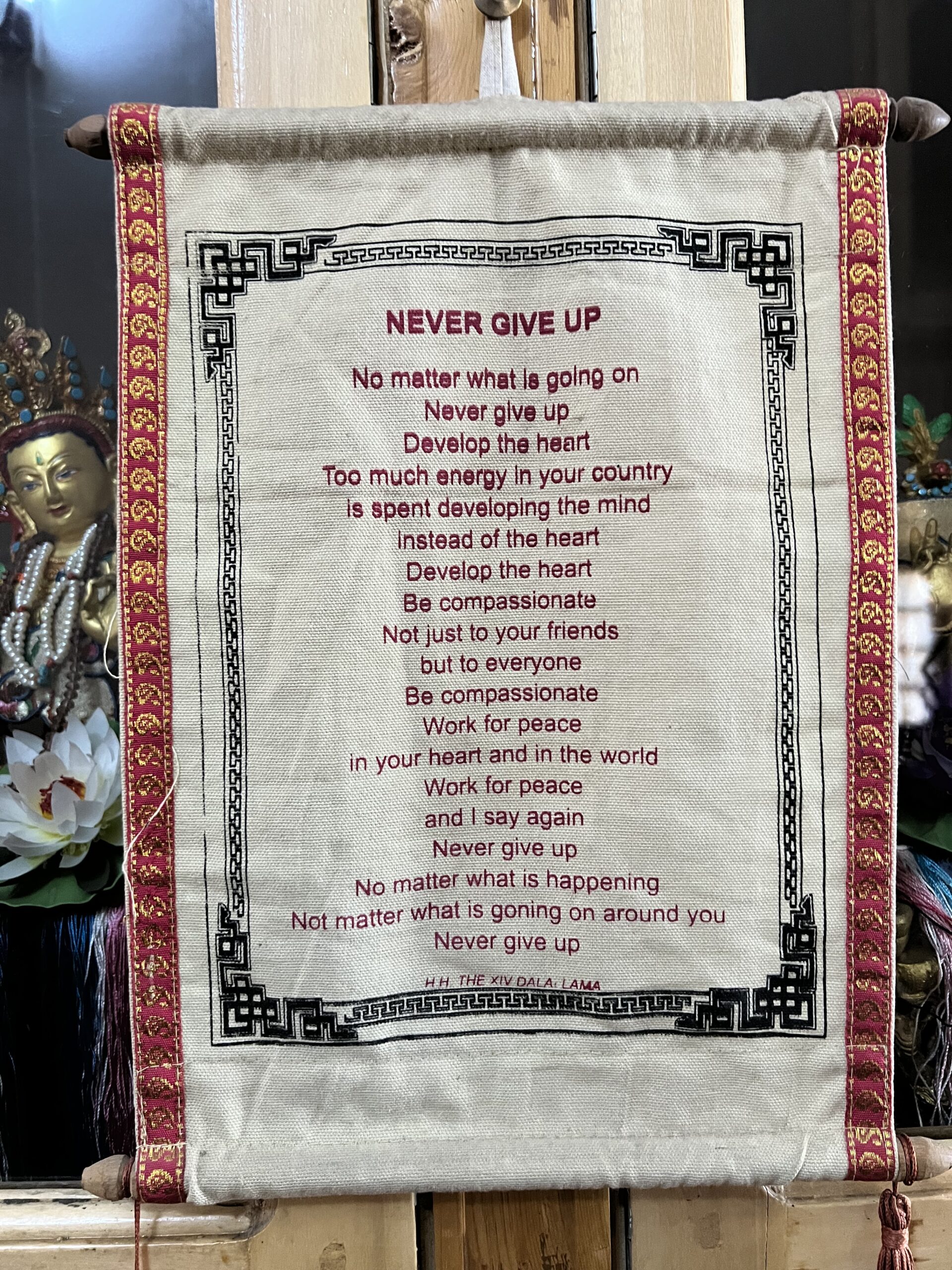
I was flipping through my photos when I found this one—words painted on a monastery wall in Diskit, Nubra valley of Ladakh.

A simple message, but powerful:

“Never give up. Develop the heart. Too much energy is spent developing the mind instead of the heart.”

It made me pause.

We chase sharp minds. Smarter, faster, more efficient—that’s the dream. We analyse, strategise, optimise. But how often do we develop the heart?

Imagine if compassion was a skill, like coding or negotiation. If kindness was a KPI. If success was measured not just by what we built, but by how we made people feel.

The mind is important. But it can’t do the job alone. Logic without empathy is cold. Intelligence without kindness can be dangerous. A brilliant mind with no heart can justify anything—even things that hurt people.

Developing the heart is different. It means listening, even when you disagree. Choosing understanding over being right. Caring—not just for friends, but for strangers too.

Nalla Sivam, the unforgettable character from Anbe Sivam, puts it beautifully:
“தயவுதான் கடவுள். எது நடந்தாலும் மனிதன் மனிதனாக இருக்கணும்.”
(“Compassion is God. No matter what happens, a person must remain human.”)

It’s easy to be clever. It’s harder to be kind. Some think kindness is weakness—a soft option, a surrender. It’s not. Kindness is strength. Empathy takes effort. It’s much easier to argue than to understand.

A friend asked me, “But how do you define it exactly?” I told him that’s part of the problem. Not everything needs a precise formula. Sometimes, it’s just about helping people see that they too can help.

If that doesn’t make sense, well, it’s ok. That’s part of the deal.

To be ok with imperfection. To see the human beyond. And notice the deep, jagged edges of people and not miss them in the quest for surface-level perfection.

That’s what developing the heart is about.

This is perhaps the best message I can give myself. A note to self.

Peppa Pig is Getting a Sibling. Chaos is Coming.

Peppa Pig is Getting a Sibling. Life Will Never Be the Same.

I walked into a hotel. It was a warm Sunday morning in cold Guwahati. On the bed, a towel had been folded into something soft and cuddly. My mind leapt to Peppa Pig. Years of watching the show had clearly left a mark.

There was a time when Peppa and George were permanent residents in our home. My daughter, in her early years, was hooked. Every day was a Peppa day. Every evening was a George evening. She even looked for muddy puddles in our apartment complex. There were none. Great disappointment.

I was roped in, of course. I have watched many Peppa Pig episodes. Some, multiple times. Enough to know that Daddy Pig is not as useless as he looks, that Suzy Sheep is a questionable friend, and that Peppa is, quite honestly, a bit of a bully.

But let’s talk business. The Peppa Pig franchise is massive. Multi-billion-dollar massive. Toys, books, theme parks, endless merchandise. Peppa-branded spaghetti exists. So do Peppa shoes, Peppa toothpaste, and Peppa bedding. Kids love it. Parents buy it. The empire keeps growing.

And now, change is in the air.

In February 2025, it was announced that Mama Pig is expecting. Peppa Pig is getting a sibling. George is no longer the baby of the house. Chaos is guaranteed.

What could change?

• George loses his ‘baby of the house’ status. Tears may follow.

• Peppa takes charge. Expect unsolicited parenting tips from a 4-year-old pig.

• Daddy Pig looks overwhelmed. Because, of course.

Thankfully, my daughter is past her Peppa Pig phase. But nostalgia reigns. And when I read that a new baby was on the way, I couldn’t help but say oink oink and read it out to my young miss. She rolled her eyes. I felt old.

Life is about change. Even in the world of animated pigs.

The Scoop on Happiness: Ice Cream is Science

Ice Cream Happiness is not just a feeling—it’s science. Researchers—real ones—put people in an MRI machine and fed them vanilla ice cream. The results? Their brains lit up like Deepavali lamps. A study conducted by the Institute of Psychiatry in London found that eating ice cream activated the orbitofrontal cortex, the part of the brain associated with pleasure and reward.

Our ancestors weren’t spoiled for choice. Before supermarkets and food delivery apps, food was hard to find. Fat and sugar meant survival. So, the brain rewarded every bite with a dose of joy. Thousands of years later, we don’t need to hoard calories, but the brain still thinks we do. Which is why ice cream makes us happy.

Some say joy can be found in other things. These people are wrong. The MRI scans don’t lie. The next time someone judges my double scoop, I am going to point them to science.

Interestingly, the research also found that different flavours trigger different responses. Vanilla, the classic choice, brings a sense of comfort and nostalgia. Chocolate lights up more intense pleasure centers. But whatever your preference, the effect is undeniable—ice cream is a shortcut to happiness.

This might explain why ice cream parlours have been cultural landmarks for generations. From old-school softy vendors to artisanal gelato shops, they’ve always been places of joy. Whether celebrating a victory or nursing heartbreak, the cure is often found in a cone or a cup.

Speaking of nostalgia, there was an Arun Ice Cream shop at Simmakkal, Madurai. An odd place for an ice cream shop. In the middle of a busy road with no parking. But that never mattered. Arun Ice Cream was the first big name in mass retail ice cream in my life! Before Arun, ice cream was a fleeting treat, not a destination. Arun changed that. It gave ice cream a home. A shop. A menu.

The pushcart was replaced by the thrill of stepping into a store, choosing from a board full of flavours, and watching the shopkeeper handover happiness in a cup.

Or better still, a slice of Cassatta. A rainbow of flavours with a soft cake surprise at one end. The ultimate jackpot. The store in Simmakkal is long gone, but I look at the place fondly. Arun Ice Cream remains special. Their playful ads, delightful products, and bold entrepreneurship have kept them a favourite.

But back then? Well, those were the days. Sparse traffic. Slow afternoons. Ice cream melting slightly before the first bite.

Me, my brother, and dad would drive there on his good old Hero Honda. The wind in our faces, the thrill of the ride, and the promise of ice cream at the end of it—it was an adventure of its own. I can’t imagine how that would be possible now, with the traffic and chaos. But back then, it was simple. And sweet. Ice cream happiness was worth living for!

And by the way, this is not the first time I write about ice creams here.

Check out my ‘paal’ ice post here from 2008.

Or from 2014. Looks like I have been accessing ice cream happiness for a long time.

Now, if you’ll excuse me, I have important research to do. With a tub of filter coffee ice cream. Science, you see.

How Deep is Deep?

Depth is having its moment. With a nod to DeepSeek, it’s shaking things up. Portfolios have suffered deep losses, and the technology world — after pouring billions from their deep pockets into AI — is staring at deep consternation. Even Nvidia, the darling of the AI boom, is in the deep red.

And it’s not just the markets. WhatsApp groups are buzzing with deep discussions on DeepSeek. Even the neighbourhood aunty — who usually reserves her advice for hair oil and weekend shopping deals — stopped me in the lift and asked, “What is this deep stuff everyone’s talking about?” Clearly, DeepSeek has gone mainstream.

Plus, most sensational things these days have “deep” in them: Deep Fakes, Deep State. Perhaps, depth has become the vicarious flavour of the season, albeit with its own mix of intrigue and fear.

But what is deep, really?

For far too long, we’ve celebrated the triumphant dance of skimming the surface. The quick wins. The instant applause. The obsession with cheaper, faster, better. Deeper rarely makes it to the conversation. Yet ironically, going deeper is often the best way to achieve all those surface-level wins — in the long run.

Of course, the long run comes with its caveat. As someone once quipped, “In the long run, we are all dead.” So depth has been sacrificed at the altar of speed — the modern world’s favourite deity. Speed gets you attention. Depth? That takes time, patience, and work.

Albert Camus once said, “In the depth of winter, I finally learned that within me there lay an invincible summer.” Khalil Gibran added, “The deeper sorrow carves into your being, the more joy you can contain.” These aren’t just poetic musings. They remind us that depth is where life hides its surprises — if you dare to seek them.

Depth is where breakthroughs are born and resilience is built. It’s hard, messy, and sometimes downright terrifying. It involves steady work — getting better at what you do, step by step, without stopping to glance at the podium. It’s about chipping away, persistently, even when no one’s watching. And that? That’s an ask.

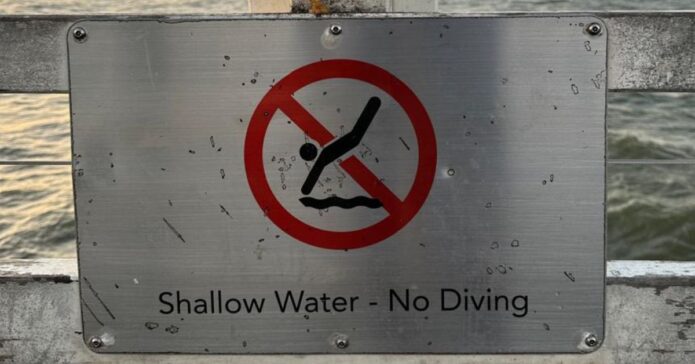
The surface is tempting. It’s where the shiny ideas float. It’s where blog posts like this one live. Quick, easy, and shallow. Because let’s face it — while everyone is exploring the depth of Deepseek, this might just be another surface-level discussion.

But here’s the thing: the surface only sparkles because of what lies beneath. Without depth, there’s no brilliance. So, maybe it’s time to stop writing and start diving. Until then, dear reader, let’s enjoy the shimmer on top.

Because going deep? That’s where the real treasure is. And when you rise, you might just find your own invincible summer. Or at the very least, an answer for aunty in the lift.