Books

Books in the Time of Dopamine

The Bangalore Literature Festival has been around since 2012, but I always managed to miss it. My first glimpse of it was through friends and colleagues at Founding Fuel, Charles Assisi and NS Ramnath, authors of The Aadhaar Effect, when they spoke at the festival years ago. Since then I have been meaning to attend. Something or the other kept coming in the way. Then I read the founder’s comment on Founding Fuel about moving the festival from the five-star comfort of The Lalit Ashok to the wide open public grounds of Freedom Park. I remember thinking, Freedom Park? Interesting. The irony and the possibilities jumped out at once.

And so I finally went. The first thing that greeted me was a tall mosaic figure holding a bright red surfboard-like object with the word Freedom splashed across it. Not exactly what the British officers had in mind when they built the place, but a cheerful indication of what the day held. A few steps further was the bright @blrlitfest sign in pinks and blues. If you ever needed proof that literature can trend, this was it.

If you want to experience the full irony of modern life, go to a place once built to keep people in and watch thousands walk in voluntarily, some even jogging, to attend a literature festival. Freedom Park, the former Central Jail of Bangalore, is now a pleasant expanse of trees, sunlight, ideas, and, for a day at least, more book-loving humans than you could shake a bookmark at.

The symbolism was impossible to miss. Once, Freedom Park held prisoners in barracks with concrete beds and narrow passageways where freedom was a rumour. Now those same spaces hosted sessions on Sanskrit, parenting, news, men’s rights, and All India Radio. Chairs and yoga mats were laid out neatly across old prison beds, and people sat on them happily, notebooks open, as if taking notes in jail was the most normal thing in the world.

Bayonets and Books!

The watchtower stood tall and white in the centre, looking gently puzzled by its new job of overseeing conversations instead of convicts. A sepoy cast in stone held his rifle and stared ahead, while festival banners fluttered around him. If he ever imagined he would spend eternity watching people queue for author signings and filter coffee, he revealed nothing.

Entry was through two long parallel walls once built to contain bodies. In the evening they glowed red and seemed delighted to welcome minds instead. I could almost hear Bill Bryson remarking how human beings are the only species that would turn a former prison into a venue for people who willingly sit for hours listening to strangers discuss how to live better, write better, and occasionally argue better.

Inside the Festival: Ideas, People, and a Whiff of Possibility

The crowd was a marvellous pot-pourri. Teenagers with tote bags. Elderly couples who looked like they had stepped straight out of a Sunday crossword. Children trotting towards the #CLF area, drawn to colourful cloth canopies and cheerful storytellers. And of course a smattering of stars from Day One. Banu Mushtaq. Vir Das. Santosh Desai. Vivek Shanbag. And Shashi Tharoor, freshly returned from shaking hands with Vladimir Putin, which is not a sentence I ever expected to write. Yet there he was, surrounded by admirers, looking as though world diplomacy was merely a warm-up act for a weekend lit fest in Bangalore.
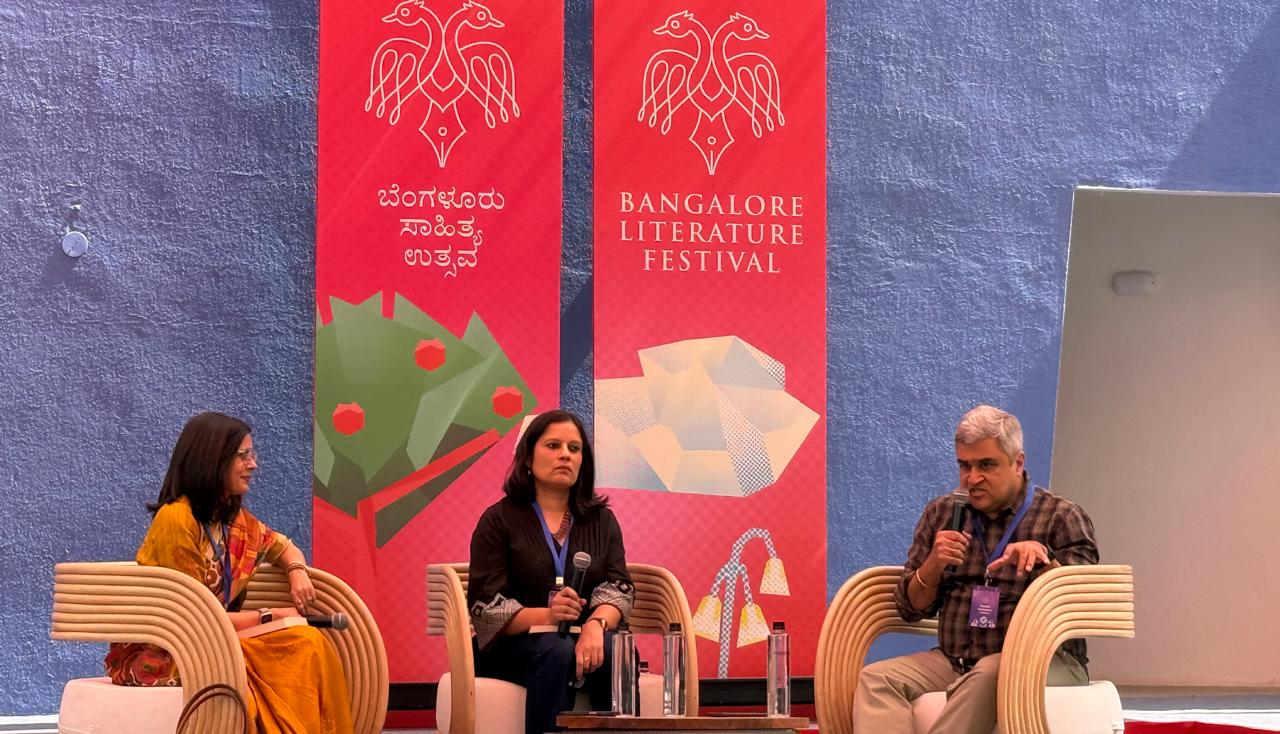
What I enjoyed most was how many remarkable authors simply wandered about. No entourage. No velvet ropes. You could walk up, say hello, and they would smile like old friends. In a world where even mid-tier influencers travel with ring lights, this felt wonderfully human. A free world, at least on that patch of reclaimed earth.

The children’s section was buzzing. Under a rainbow of cloth shades, kids sat on red chairs and listened wide-eyed to storytellers and wildlife experts. A far cry from my childhood, when literary glamour meant reading an author interview in The Hindu framed stiffly against a bookshelf. These children had open skies, soft grass, and sessions under trees. My younger self would not have known where to look.

There was also the small matter of the prison of devices. Everywhere I looked, people had put their phones away. Not in silent mode. Not in airplane mode. Properly away. Buried in bags. Forgotten. Occasionally taken out to check programme changes, especially after the Indigo fiasco caused some authors to miss their slots. It was as though the old walls had agreed to keep the devices inside and let the humans escape.

The fashion added its own subplot to the day. There were the formal types in suits. The linen types whose clothes took a moment to arrive after they did. The tight-fit types who seemed to have been sentenced to mild compression. Prints with camels, checks, stripes, feathers, hats, turbans. Greens, blues, greys, and salt-pepper combinations that could have been a paint chart. A riot, and a joyful one, united by a love for books.

I also met a few old friends, people I had worked with years ago. Some were authors now. We talked about books we were reading and books we were pretending to read. We shared recommendations. We spoke of manuscripts in progress and our quiet ambitions to one day contribute something that would sit on a table like the ones before us. These small reunions made the day feel less like an event and more like a homecoming.

Book buying was brisk. I picked up a few myself. At the end of it all, the young lady announced proudly that they accepted no credit cards. Instant debits from bank accounts are perhaps the truest measure of commitment. People paid anyway. I did too.

The organisers deserve every bit of credit. They created something warm, open, and quietly defiant at a time when reading is supposedly declining and AI, we are told, is sharpening its knives for books.

But at Freedom Park, of all places, there was a whiff of possibility. Under the watchtower that once surveyed prisoners, I watched hundreds of people sit under an open sky, listening, questioning, dreaming, and shaping answers they would take away.

Reading keeps us human. Writing keeps us honest. And festivals like these remind us that imagination is still, thankfully, unjailable.

Picking on memory

Books have a way of growing on you. Sometimes when you read an old book again, you see new things. It is but obvious that the book is the same but you are new. Some books evoke memories like most others don’t far they embed themselves deep into the mind. Here is one: The Adventures of Tom Sawyer by Mark Twain.

Tom Sawyer and Huckleberry Finn. I remember them from school. My school life resurfaces every time I chance upon someone with a name Tom or with a chance reference to anything remotely connected to the fascinating novel. A white fence is one of them.

The incident about the white fence goes something like this. Tom skips school and is meted out a punishment: paint a fence white. He goes about enlisting a bunch of friends to partake some of their prized possessions to be allowed the privilege of the fence. It is a fascinating read and over the years ‘Paint Fence White’ has stood in for several things as I moved roles, managers and teams:).

What is exciting to one is a chore to another. With skill and some luck, you can make what is exciting look like a chore. And with some imagination and a sense of play, it can indeed be so!

We went Strawberry picking in somewhere close to the Bay Area. The little miss had a giant whale of a time. Yes.
Giant. Whale. Of. A. Time.

The set up is simple.
You drive to the farm.
You pick boxes.
You pick the produce.
You put the produce in the box.
You bring it back. ( You eat a few as well)
You weigh the produce.
You do the math of how much you need to pay.
You swipe your card.
You pack your stuff.
You leave in joy.
And then, when you come home, you ask for more.

I mean, isn’t this awesome.

Sure, strawberry picking is not something that you do daily and it is one of those things that you do once in a while. To seek different experiences and tell stories to ourselves ( and to the world) about those experiences make our lives. Or so I think.

And as the Pacific Ocean’s blustery moods rearranged the clouds above us in a hurry, kids punctuated the moves with shrieks of joy. Strawberries were the bright red trophies to take home along with a fresh coat of pride on tired parents.

Speaking of parents, I remember running about amongst paddy and sugarcane fields with my dad just letting me and my brother be. We didn’t have anything to pick those days except a fight or two between us. I recall the sweltering heat and the odd steady rain. We were free to do as we liked. Even as I wonder why we did precious little, I realise, we grew up.

Or so I think.

The Tread Within: How Character Shapes Our Marks

The treads on tyres leave their distinct marks on the ground, telling a story of grip, direction, and purpose.

It’s the same with us. What’s inside shapes how we behave, speak, and leave our mark on the world. When the tread is strong, it shows in our character and actions.

But when the tread wears out—when we let life grind us down—the marks we leave lose their distinctiveness. A bald tyre leaves no meaningful trace.

The tread within matters. Nurture it, renew it, and ensure it’s ready for the road ahead. That’s how you leave a lasting mark.

A book & an open road

Decades ago, as we tossed empty ideas into the evening air, my dad jumped to reach a book from his collection. He passed it my way with a flourish and care that he reserved for books he had a special affection for.

The cover said “Zen and the Art of Motorcycle Maintenance” by Robert Pirsig. I thought it was a bag of tricks that would stop my incessant trips to the mechanic (and the consequent demands it had on his frayed wallet). But within a few minutes I spotted in the foreword: “It’s not very factual on motorcycles, either.” That was indication enough that what was to come was not as much of a trip to the garage as much as my seeking debates with dad.

Pirsig passed away last week. It caused me to dust off the dog-eared book and go over several underlined passages and random remarks with a firmer handwriting. Pirsig’s account of a motorcycle trip across America with his 11-year-old son and two other friends was not so much a travelogue as it was a treatise. As a young man, the allure of the bike and the open road held together the space for my exploration of his deeper musings. I remember reading and rereading the book. In part for what it offered, but also because I wasn’t able to comprehend all that it offered at one go.

It was much later that I learnt that the book had sold a million copies in the first year and that Pirsig had spent time in Asia (and India) as well. It suddenly seemed to hold greater potency than it had struck me as having when I first read it. The book was published in 1974 but its meandering conversations stand as a poignant pointer for us to examine our world and the times we live in today as well.

The book is set in the ’60s and ’70s. When America and the world was coming to terms with all the scientific advancements and the entirety of its consequences: industrialisation, mass production and other aftermaths including the hippie culture.

One particular incident from the book has stayed with me. Where the narrator takes the motorcycle to the mechanics and is left with a less than happy experience. To put it mildly.

It dawned on me then that a mere mastery over tools is as incomplete an experience as thinking of a home as just bricks and concrete. A home is defined by those who live in it. Similarly much of meaning emerges from our approach to our tools, our work and our lives. Just tools or a mere mastery over them takes us a good distance but it doesn’t complete the journey.

Many pages are devoted to the idea of ‘quality’ in the book. Quality as an unseen yet omnipresent way of working and living. (And not as a limited measure of a person, product or process.) The dusting off of the book brought me front and square with several aspects that have continued to stay with me, both consciously and otherwise: the criticality of the whole self, the heft in exploration and the need to reflect on the lenses we use to view the world around us, etc. But the most important elements, I realise, are the importance of nuance and the need to expand our horizons through reflection, dialogue and conversation.

Nuance, diversity and dialogue have been at the core of several things that we do at Founding Fuel. Take for instance the stellar conversation my colleague NS Ramnath has had with Nicholas Agar, author of The Sceptical Optimist. Do take the time to dive into the piece titled The Sceptical Optimist: A philosopher’s take on technological progress. There are several gems in there that made me pause and ponder over the inevitability of technological progress and the importance of comprehending its consequences.

Technology in the connected world of today is all pervasive. Having said that, both wholesome adoption or blind rejection of technology limit our living in these modern times. Deep questioning, dialogue and inclusive discussions are necessary. As Tom Brokaw said “… it will do us little good to wire the world if we short-circuit our souls”.

There is a heap of work to be done. Even as the spotlight remains trained on the tools and all the glamour associated with what they can do, there are other spaces that we need to train our attention on as well. Especially in the space where technology intersects with our lives and changes us and our societies forever. I will leave you with that thought.

The other thing that I want to leave you with is an invitation to stay connected here, and subscribe to Founding Fuel’s newsletter if you haven’t already. May I also invite you to have a conversation on the content here with someone you know. You never know where one conversation can lead you to.

In the spirit of Zen and the Art of Motorcycle Maintenance, I am going to indulge myself by leaving you with three quotes from the book to mull over.

“‘What’s new?’ is an interesting and broadening eternal question, but one which, if pursued exclusively, results only in an endless parade of trivia and fashion, the silt of tomorrow. I would like, instead, to be concerned with the question ‘What is best?’”

“If you want to build a factory, or fix a motorcycle, or set a nation right without getting stuck, then classical, structured, dualistic subject-object knowledge, although necessary, isn’t enough. You have to have some feeling for the quality of the work. You have to have a sense of what’s good.”

“The place to improve the world is first in one’s own heart and head and hands, and then work outward from there.”


This piece was first published here.

Building an “attitude of interest” – Humble Inquiry


My dad used to always tell me that the virtues in keeping things simple, easy and small was so huge, that it gets often missed. His knack for keeping things real simple and constantly seek beyond what seemed obvious or what were ‘mainstream voices’, got him untold riches. Relationships. Ideas. Discoveries. And a wide spectrum of people who wanted to work with him. The essence of it was all about having an abundance of curiosity and an attitude of discovery. More of dad later.

Now about Humble Inquiry.

HI

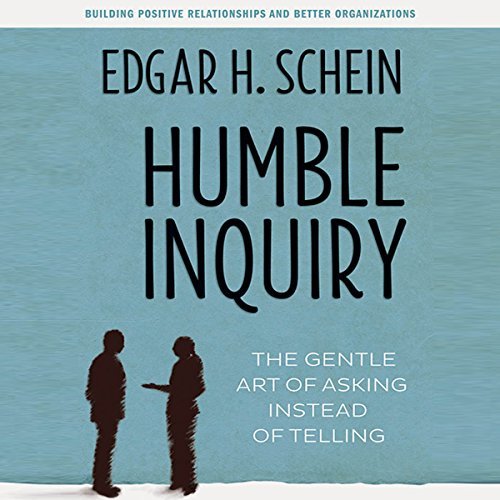
When Vivek Patwardhan recommends a book, I close my eyes and buy it.  Thats that. When he recommended “Humble Inquiry” by Edgar Schein, it was no different. Having consumed several of Edgar Schein‘s work in the past (and occasionally foisting it on MBA students who I taught), I was mildly surprised that I hadn’t come across this work before.  That it was dated June 2013, was some consolation!

Schein writes at the end of the book, “This book represents a culmination and distillation of my 50 years of work as a social and organisational psychologist“.  That one comment should be suffice to get anyone get started. But there is more. Here is another quote. “The current book Humble Inquiry brings together all of these trends in showing how culture and individual behaviour interact, and what it will take in the way of counterculture behaviour to deal with the changes that are happening in the world“.

In more than one way, the last few posts of mine have been about changes that are occurring in the world and our ways of dealing with them. Be it facilitation, Working Out Loud or even ‘Social’ for that matter.  This book settles that theme remarkably well for me. My own stumbling across such themes is either a fortuitous consequence or perhaps I am viewing everything that I am stumbling across with my current lens.

From very early on, Schein anchors his argument as an alternative to the popular mainstream culture of ‘tell’. “We also live in a structured society in which building relationships is not as important as task accomplishment in which it is appropriate and expected that the subordinate does more asking that telling, while the boss does more telling that asking. Having to ask is a sign of weakness or ignorance, so we avoid it as much as possible”. 

He drops anchor on curiosity, to explore and a willingness to ask questions to which we do not already know the answer.

The book is insightful in more ways than one. It is a read that I would recommend to any leader aspiring to lead large organisations now. And more importantly, in the future. The examples are lucid and pointed. Before you assume that the book is a set of skills about asking questions, let me hasten to add, that it is far from that. In fact, Schein himself states explicitly at several places. “The kind of inquiry I am talking about derives from an attitude of interest and curiosity“.

The book has several parts to it, stretching from building a case for it, articulating what it is and what could be possible inhibitors and ideas about developing this attitude. The weaving in of Humble Inquiry through the windows of simple frameworks like Johari Window and the ORJI (Observation – Reaction – Judgement – Intervention ) model helps in making it contextual and practical.

Its an easy, simple read. Devoid of jargon. Its the best Rs.123/- that I have spent in a long time!

This book is a superlative, if you are in the talent development, culture change arena. If you are an executive coach or are in pursuit of perfecting your skills, this could well be the centrepiece of your practice. Of course, this book holds a bundle of benefits for anyone serious about leading teams in our current times!

The scepter of uncertainty envelopes every leader’s ornamental bauble. Knowledge and expertise are far too distributed within and outside the precincts of the firewall.  The ‘attitude’ of ‘Humlbe Inquiry”, when coated with ‘social skills’ adds another rather potent dimension to the modern day leader’s quiver.

And, dad. It was while reading this book that realisation dawned that what endeared him to many was his consummate practicing of ‘Humble Inquiry’. His innate ability to ask a question with warmth, genuine interest and wait for answers used to have many wanting to talk to him. This book reminded me of him. Thats one more reason that this book stays on my mind.